
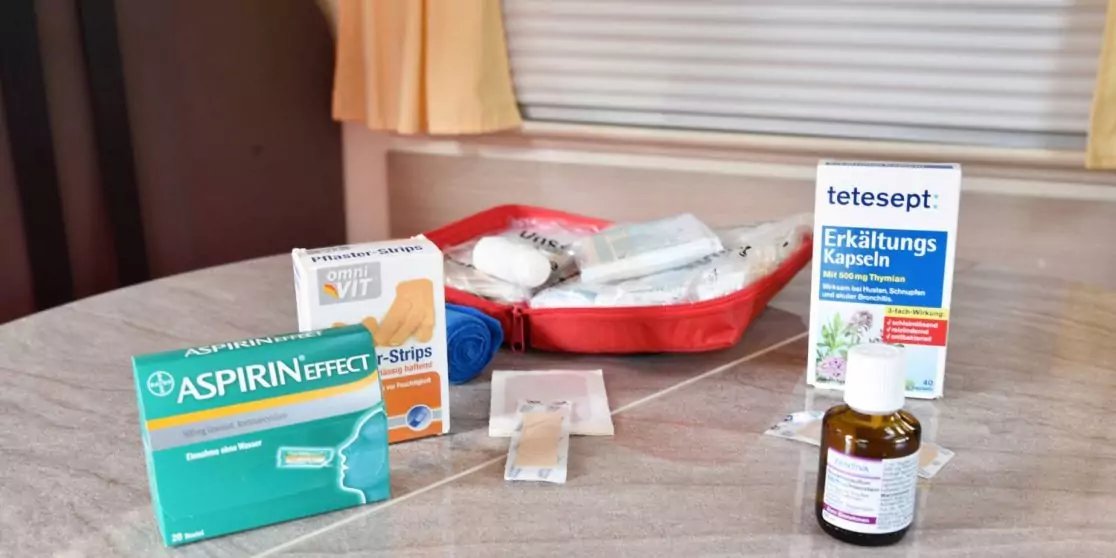
This belongs in the first-aid kit of campers
Medicines and bandages for all (emergency) cases
Cuando se planifica un viaje, casi nadie piensa en los riesgos para la salud. Por esto deberías tener en cuenta también los medicamentos y los vendajes como parte de los preparativos de tus vacaciones, ya que las enfermedades y las lesiones no se toman vacaciones.
Table of contents
- Here’s why it makes sense to bring a first-aid kit on a camping holiday
- Basic advice on the use of medicines
- Basic equipment for the first-aid kit
- Additional medicines for the first-aid kit
- The first-aid kit for camping with children
- Special precautions for certain countries
- Conclusion: a bandage kit does not replace a first-aid kit
Here’s why it makes sense to bring a first-aid kit on a camping holiday
Sometimes the body just gives out. And sometimes we catch an illness on holiday or sustain an injury. The good news: not every illness necessarily requires a visit to the doctor. In many cases, you can help yourself, at least temporarily, provided you have the necessary medicines and bandages in your luggage. A well-stocked first-aid kit can ensure a faster recovery.
There are several reasons for a well-stocked first-aid kit. Usually, it is important to control pain and symptoms as quickly as possible during illness. Having the appropriate medication in your luggage gives you a valuable time advantage. Otherwise, you would have to look for the nearest pharmacy at your holiday destination. Additionally, communication difficulties abroad can make finding the right medicine more challenging.
Basic advice on the use of medicines
- Only take medicines on holiday that you have taken before without complications. Unknown products can cause undesirable side effects.
- Check once a year that the expiry date of all medicines has not passed. Important: if liquids or ointments have been opened, their effectiveness may already be impaired.
- If travelling to particularly warm countries, some medicines must be stored in the refrigerator. Exact instructions can be found in the respective package leaflet.
Basic equipment for the first-aid kit
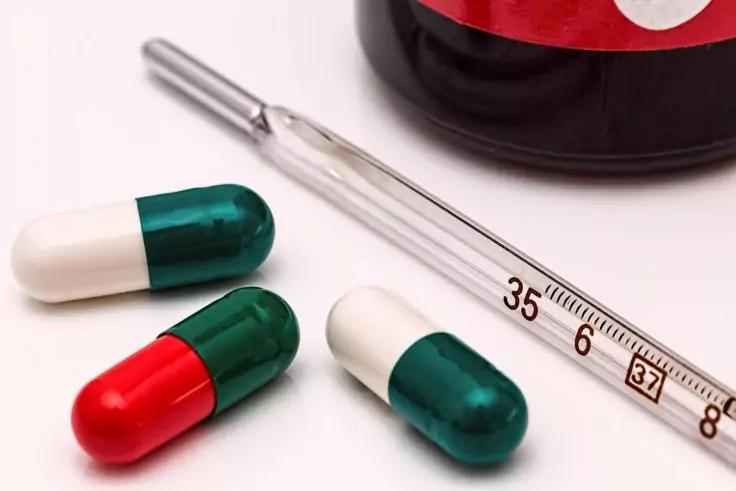
Travel medicine kits are available for purchase. Depending on the scope and equipment, prices range between 20 and 50 euros. Usually, all medicines and dressing materials are stored in a bag or small case. You can also assemble your own first-aid kit. The following items should not be missing.
- Individual medicines: all medicines you need to take regularly, e.g., for a chronic illness. Especially before travelling abroad, calculate your needs carefully, as some medicines are hard to obtain on the road.
- Wound disinfection: a disinfectant or spray is essential in every first-aid kit. The spray prevents the wound from becoming inflamed.
- Painkillers: medications like aspirin and ibuprofen relieve pain in various parts of the body. Available in different forms. Tablets take up little space and are therefore recommended.
- Bandage material: wounds must be treated with plasters, wound compresses, or gauze bandages depending on the injury. Adhesive tape, scissors, and possibly splinter tweezers are needed. These items are usually included in a car bandage kit.
- Clinical thermometer: body temperature can indicate the seriousness of some illnesses. Whether you use a simple rectal thermometer or a high-end forehead/ear thermometer is up to you. It is important that it is calibrated and approved for medical use.
Additional medicines for the first-aid kit
The following medicines can enhance your first-aid kit but are not mandatory. Consider whether you will need them. For example, if you often suffer from constipation, include an appropriate medicine.
The extended range includes medicines for …
- … nausea
- … diarrhoea
- … constipation
- … cold
- … sore throat
- … eye discomfort
Especially in warm seasons, insect bites can ruin a camping holiday. Depending on your destination, an antihistamine gel or sting healer may be useful.
Find a detailed guide on preventing and treating insect bites here.
The first-aid kit for camping with children
Children love to romp and frolic. Due to their activity, they are at higher risk of injuries. For young children, include small, child-friendly plasters in the first-aid kit. Wound and healing ointments should also not be missing. Otherwise, the same recommendations as for adults apply.
The first-aid kit for camping with a dog
If you take your dog on holiday, your first-aid kit should include certain medicines and dressing materials for it. Especially recommended for a dog on holiday are:
- Eye rinse solution
- Medicines for nausea and diarrhoea, especially charcoal tablets
- Wound disinfection
- Bandages
- Clinical thermometer (for dog use only)
- Muzzle (to protect the dog in case of injury)
- Anti-tick remedy
- Emergency drops (dogs have special dosage)
Especially when travelling abroad, the vaccination certificate for the dog (EU pet passport) should not be missing.
Special precautions for certain countries

In some countries, the risk of certain diseases or infections is particularly high. A typical example is malaria in tropical climates. The Foreign Office also recommends special precautions for less exotic countries. Tick vaccination is advised for Finland and Estonia due to increased risk of early summer meningoencephalitis (FSME). When camping in tick areas, include a tick tweezers in the first-aid kit.
Some insect-borne diseases are difficult or impossible to treat specifically, like West Nile fever, which tourists may contract in Greece during summer. In such cases, preventive measures (e.g., mosquito repellent and nets) are useful.
Country-specific health risk information is available online at the Foreign Office, as well as at pharmacies or your doctor’s office.
Conclusion: a bandage kit does not replace a first-aid kit
A well-stocked first-aid kit can save your holiday in an emergency. Take time to check its contents for completeness and integrity. The first-aid kit should not be confused with a bandage kit, which is limited to injuries from traffic accidents. The first-aid kit covers a broader range of needs.