
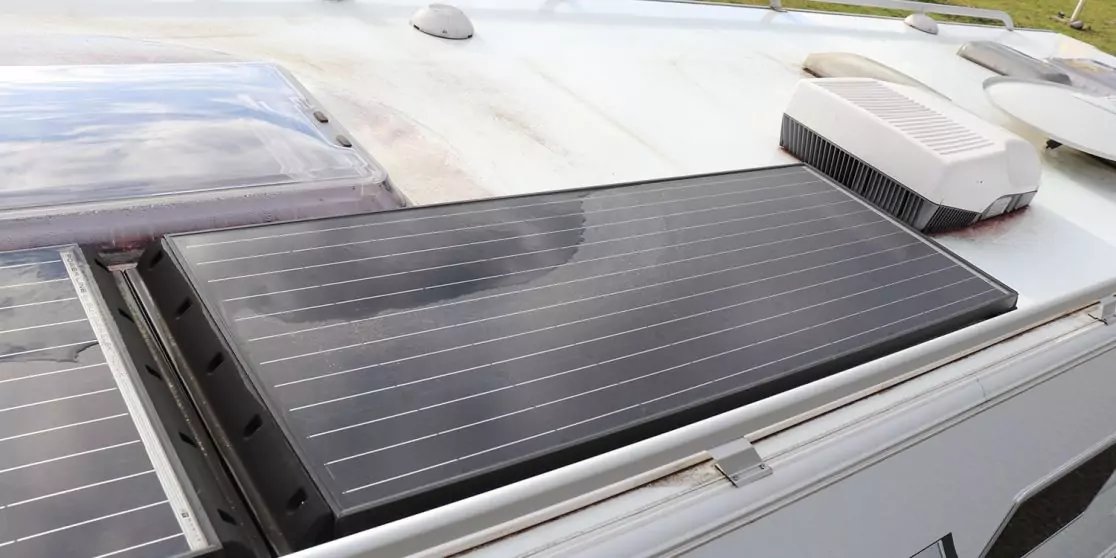



Solar system for caravan & motorhome
All information about costs, installation and possible application
Solar panels make camping much more comfortable. This allows you to charge the batteries of your motorhome or caravan even without shore power. We show you what types of solar systems there are, how much they cost and how the installation works.
Table of contents
- How does a solar system actually work?
- Types of solar systems for camping vehicles
- Which type of solar system is suitable when?
- How much power should my solar system deliver?
- What should I pay attention to when installing the solar system?
- Cost of a solar system for a motorhome
- Conclusion: free solar power for every type of camping
How does a solar system actually work?
Whether it is a large solar module on a house roof, a solar system on a motorhome or a small portable model - the operating principle is always the same. Solar energy is converted into electricity. When the sun shines, the sun’s rays hit the module. This releases positive and negative charge carriers. Voltage is created between the poles, which is converted into electricity and passed on via a cable and the solar charge controller - usually with 12 volts, rarely also with 24 volts - to a supply battery.
Solar systems for camping usually consist of two components: a solar module and a solar charge controller, which is connected before your on-board battery. This means solar power charges your batteries and allows you to operate electrical 12-volt devices in your camping vehicle for longer. If you also use an inverter, you can also operate household appliances with 230-volt power. A sine wave inverter is recommended for electronic appliances. You can find out exactly how an inverter works in detail in this blog post.
The charge controller continuously checks the battery’s charge level. As long as it is not yet fully charged, the battery continues to be charged by solar power. Once the battery is fully charged, the charge controller prevents overcharging.
Types of solar systems for camping vehicles
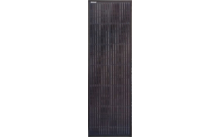
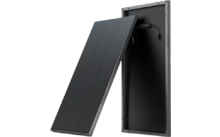
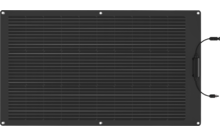
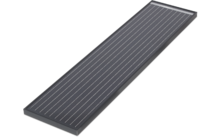
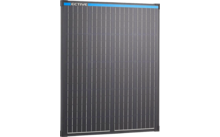
Thin-film solar modules or crystalline modules are usually used for camping systems. Monocrystalline modules are the most efficient.
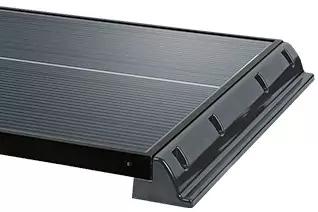
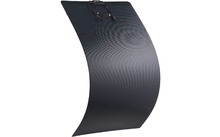
Thin-film modules: These solar systems are available as copper indium diselenide modules (CIS) or copper indium gallium diselenide modules (CIGS). These solar cells have a particularly flat design and are ideal for use as mobile solar systems. Some modules are even flexible and can be used on curved surfaces such as alcoves. Another advantage of CIS solar panels is that they can still produce electricity in poor light. However, for the same output, you need a significantly larger surface area.
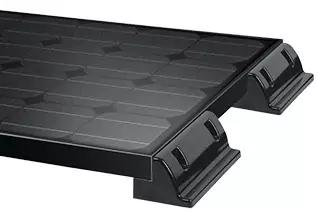
Crystalline solar modules: Silicon is used for these solar systems. The advantage of these solar panels is their higher output. However, the modules are taller and usually require an additional support.






Which type of solar system is suitable when?
Which solar module you use depends on various factors:
- Power requirements: Which battery and which devices do you want to supply with power?
- Travel period: How strong is the solar radiation, or how many hours of sunshine are there per day at your destination?
- Type of installation: Is there enough space on the roof for a solar module?
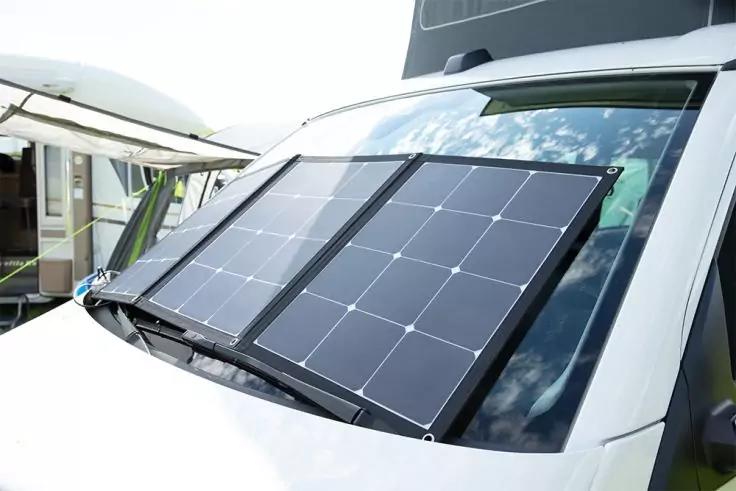
For mobile use, a monocrystalline thin-film module (CIS) is usually more suitable. Thanks to their higher energy intake, these modules are also recommended if you expect the sun at your destination to be less intense or if you often travel in wooded areas.
Mobile solar systems are also suitable for tent camping. You can either attach the foldable module directly to the outer shell of your tent or place it on a sunny surface next to your tent.
Here you can find more information about mobile solar systems.
However, if you are looking for a permanent solar solution for your touring vehicle, permanently installed monocrystalline silicon-based modules are a good choice. Their clear advantage is that they require less space and are more powerful.
Here you can find camping solar systems in the Berger online shop.
How much power should my solar system deliver?
When looking for solar systems for motorhomes, you will usually find the unit watt peak (Wp) in the performance specifications. This refers to the electrical output that a solar system provides under standardised test conditions. The unit Wp is well suited for comparing the performance of different modules.
Depending on the design, a single solar module delivers between 15 and 400 Wp. How many solar modules you need depends on your power requirements and the intensity of the sun at your travel destination. The storage capacity of the leisure battery also plays a role, as it stores the electricity produced and makes it available for your electrical appliances.
To determine the output of the solar system, you need to know your daily power requirement. To do this, write down all electrical appliances and lights that you want to use in your caravan or motorhome. Then also note how long each device is used on average per day. Based on this calculation, you can adjust the output of your solar cells. If you mainly camp in winter, you should calculate more generously, as more electricity is expected to be needed during the colder season.
The daily output of a module is given in Wh. In most cases, this value is four times the power rating in W. With a solar system delivering 800 Wh, you could therefore use a camping coffee machine with 600 W continuously for one hour and would still have 200 W available afterwards. You will not be able to operate a compressor air conditioner with a small solar system. The output of the solar system is at most sufficient for operating a low-power evaporative air conditioner.
What should I pay attention to when installing the solar system?
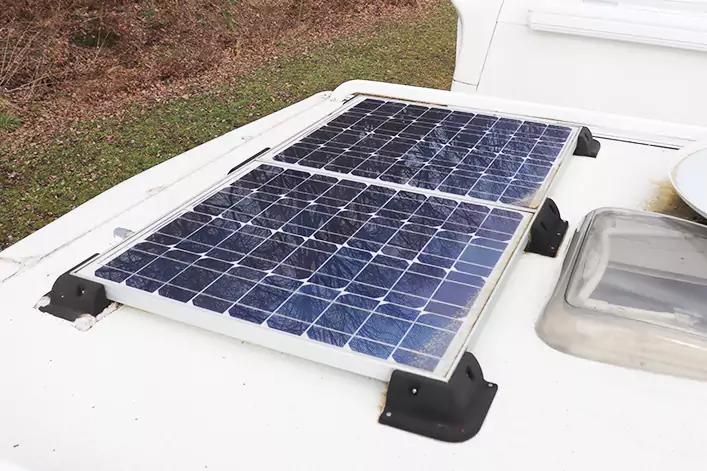
When mounting solar modules on the roof of your caravan or motorhome, it is best to use the corresponding manufacturer brackets, which are often included in the scope of delivery or even already pre-mounted on the frame. They ensure that the module is sufficiently ventilated during operation. There should always be a small gap between the module and the roof so that heat can escape and not build up, because heat always means a loss of performance.
Also make sure that
- the spot on the roof is as free from shade as possible and nothing is mounted above the module.
- the bracket is designed to withstand vibrations while driving.
- the wiring is sufficiently thick.
- the cable is routed into the interior of the caravan or motorhome in a weatherproof way. Use a roof feed-through!
- the solar module and battery are matched to each other.
- the cables arrive at a sensible point inside the vehicle, for example in the wardrobe.
- the adhesive used is still within its shelf life.
Sometimes, for reasons of space, it can also make sense to install two modules with 100 Wp each instead of one 200 Wp module.
Installation is usually easy to carry out and can be done quickly with the help of the operating instructions.
Always observe the manufacturer’s specifications for battery power and wiring.
In this blog post, you can find out more about the efficiency of solar panels.
Cost of a solar system for a motorhome
How expensive your solar system will be depends largely on how much output it has and whether it is a mobile system or a permanently installed solar system. The type of crystals used and the workmanship also play a role in the price.
Complete sets for installing a fixed crystalline solar system on a motorhome or caravan are available for less than 200 euros. A powerful mobile solar system is also available from around 400 euros.
You can find camping solar systems here in the Berger online shop.
Conclusion: free solar power for every type of camping
Solar systems for motorhomes or caravans give you more independence from power connections. Even beginners can install a solar system with comparatively little effort. What matters is that you adapt the solar panels to your needs and to your electricity storage capacity.